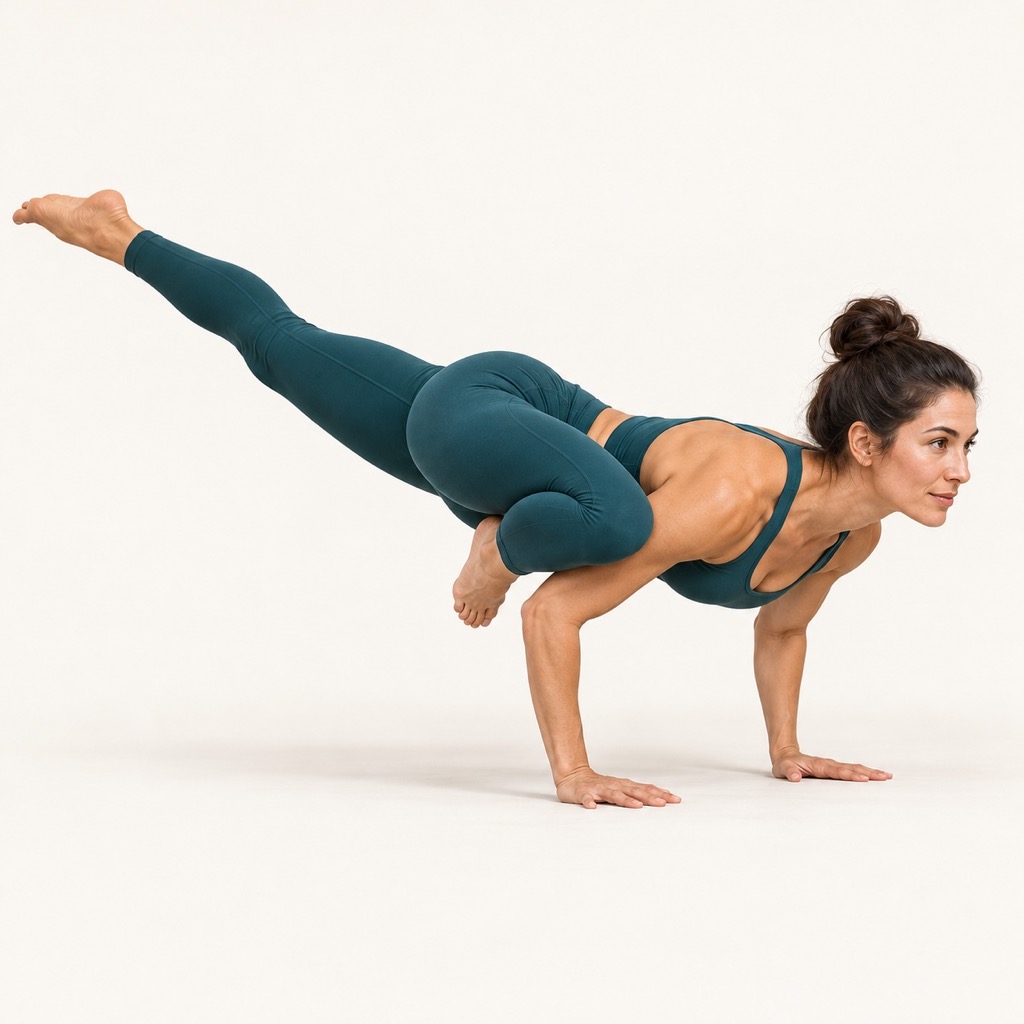
How to practice Flying Crow Pose
- Begin in a standing figure-four balance with one ankle crossed above the opposite knee.
- Fold forward, place both palms shoulder-width apart and bend the elbows as in Chaturanga.
- Rest the crossed shin across the upper arms and hook the foot securely around the opposite arm.
- Lean the chest forward, lift the standing foot and gradually extend that leg back only when the arm balance is steady.
Practice tips
- Practice the figure-four fold without lifting the standing foot.
- Place a bolster in front of the shoulders while learning the weight shift.
- Build confidence in Crow Pose and Chaturanga before attempting the full extension.
Practice note: Advanced practice only; avoid with wrist, elbow, shoulder, hip or knee pain and learn with qualified instruction.
AdvertisementReserved for a relevant, non-intrusive sponsor
Understanding Flying Crow Pose
Flying Crow Pose, also called Flying Pigeon or Eka Pada Galavasana, is an advanced arm balance built from a figure-four hip position. The crossed shin creates a shelf across the upper arms while the chest moves forward enough to counterbalance the extended back leg.
What should be learned before Flying Crow?
A steady Crow Pose, controlled Chaturanga, a comfortable standing figure-four and confidence shifting weight forward are useful foundations. Keep the back toes down until the crossed foot and shin feel securely supported.
Common practice points
- Warm the wrists and spread pressure across the whole hand.
- Look slightly forward rather than dropping the head.
- Practice the entry and exit close to the floor before extending the hold.
Prepare and progress
Review the steps before entering the pose, use the suggested modifications early, and leave enough energy for a controlled exit.
Useful preparations
Progress is not measured by how closely a pose matches a photograph. Comfort, breathing and control are more useful guides.