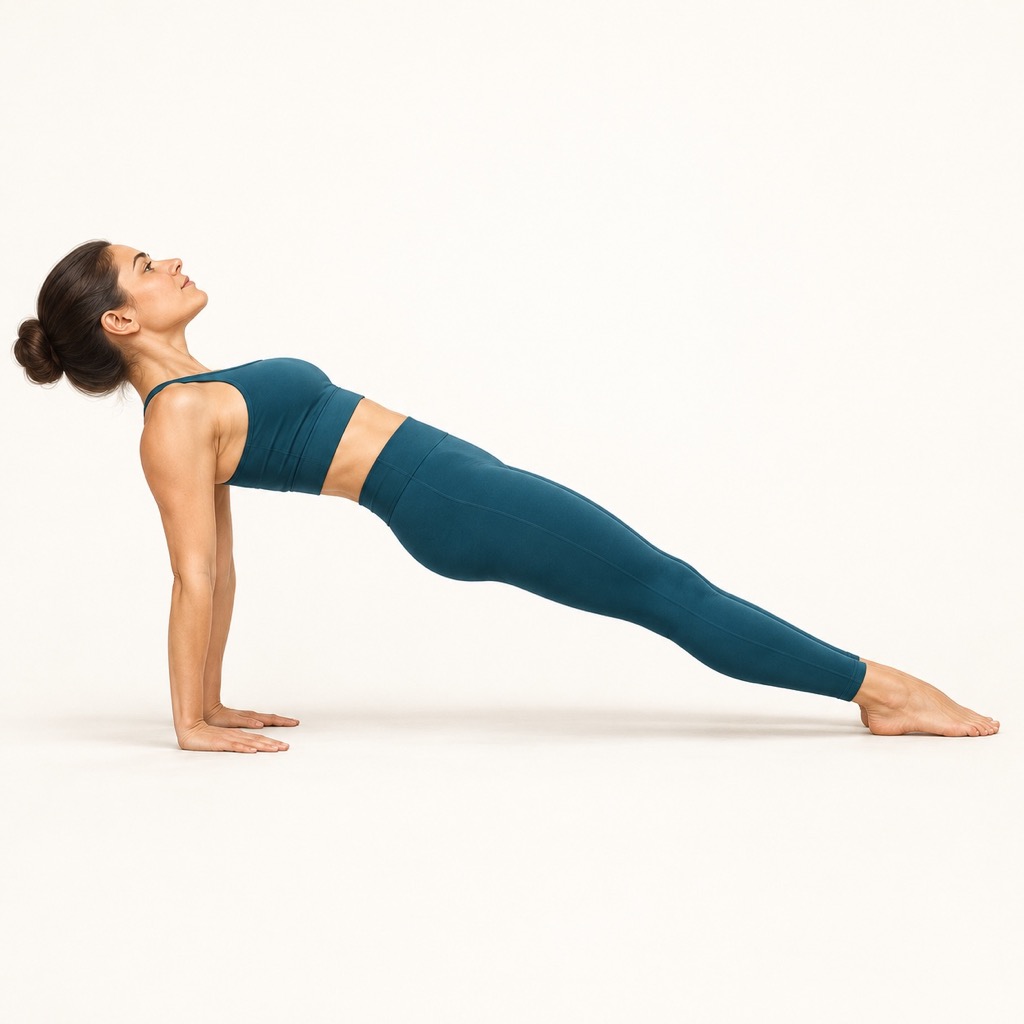
How to practice Reverse Plank Pose
- Sit in Staff Pose and place the hands several inches behind the hips with fingers pointing toward the feet or slightly outward.
- Press firmly through the hands and feet while drawing the shoulder blades toward the back ribs.
- Lift the hips and extend through both legs until the body forms a long diagonal line.
- Keep the neck neutral or gently release the head only if the neck remains comfortable.
Practice tips
- Practice Reverse Tabletop with the knees bent.
- Turn the fingers slightly outward if pointing them forward strains the wrists.
- Lift only as high as the shoulders can remain broad and supported.
Practice note: Avoid collapsing into the wrists or dropping the head back; modify for wrist, shoulder or neck concerns.
AdvertisementReserved for a relevant, non-intrusive sponsor
Understanding Reverse Plank Pose
Reverse Plank Pose, or Purvottanasana, strengthens the back body while opening the chest, shoulders and front of the hips. The hands, shoulders and feet share the work, and the head can remain neutral if releasing it back is uncomfortable.
What is the best modification for Reverse Plank?
Bend the knees and practice Reverse Tabletop. This shortens the lever, reduces demand on the shoulders and hamstrings, and makes it easier to lift the hips without collapsing into the wrists.
Common practice points
- Maintain steady breathing rather than holding through effort.
- Reduce the duration before alignment deteriorates.
- Use knees-down or supported variations while building capacity.
Prepare and progress
Review the steps before entering the pose, use the suggested modifications early, and leave enough energy for a controlled exit.
Useful preparations
Progress is not measured by how closely a pose matches a photograph. Comfort, breathing and control are more useful guides.